

Stigma is the silent conversion killer on behavioral health websites. The world still treats mental illness as something shameful. Behavioral health marketing stigma is not just a social problem. It is a measurable business problem, one that shows up directly in lower conversion rates and empty slots on the schedule.
In this post, I’ll look at how stigma affects behavioral health marketing, and offer clinic owners some practical, specific website modifications that reduce its impact on conversions.
What Stigma Does to Your Website’s Conversion Rate
Over half of people with mental health conditions avoid or delay care because of social prejudice and discrimination. (source: https://www.psychiatry.org/patients-families/stigma-and-discrimination).
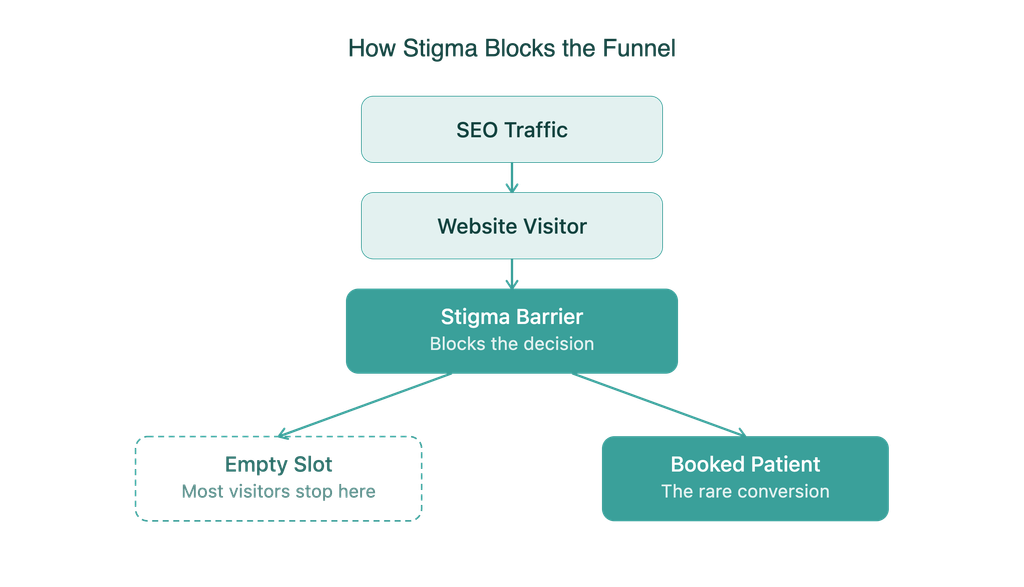
What does that mean for a clinic? SEO brings visitors to the page. Stigma is what stops them from converting. Visitors don’t become patients, and appointment slots stay empty. The ROI on that SEO investment ends up lower than it should be, which can make SEO look like an underperforming channel for behavioral health clinics. This is where mental health website conversions start to diverge from conversions in most other industries.
The good news is that this problem can be softened with careful, deliberate changes to the website. To fix low conversions in behavioral health, we first need to understand where they come from. Alongside the technical issues, unresponsive contact forms, clunky pop-ups, buttons that don’t load properly, all fixable with a standard technical SEO audit, the stigma problem runs deeper and needs to be treated with the same seriousness.
Why Does Stigma Affect Website Conversions Specifically?
Stigma changes how a visitor reads a page before they’ve decided anything. They scan for safety signals before they scan for services, and when those signals aren’t there, the drop-off is silent. It doesn’t show up as an error or a broken form, it shows up as a high bounce rate or an abandoned form, with no obvious cause unless you’re looking for stigma specifically. That’s exactly why this deserves its own conversion audit, separate from a technical one.
The Conversion Killers Tied to Stigma
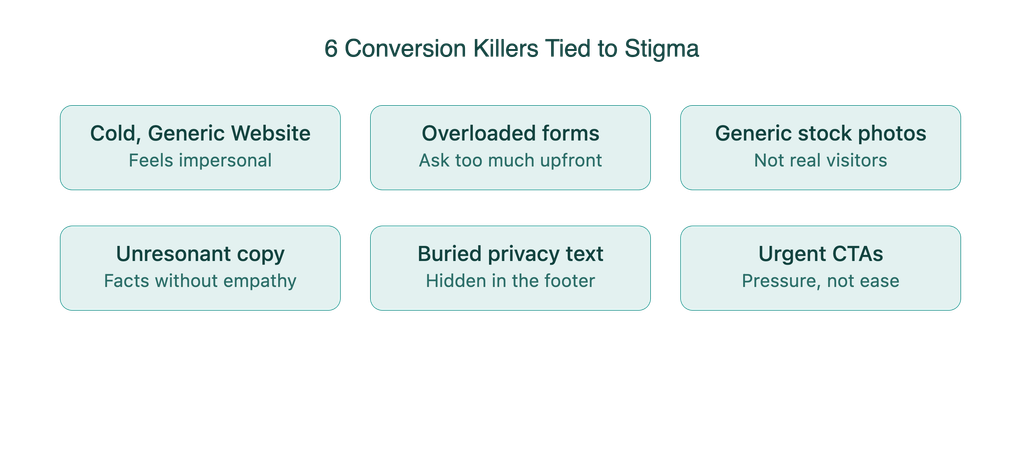
My experience working with behavioral health websites has taught me that certain subtle site elements can trigger stigma and quietly reduce conversions. Most of them come down to copy, navigation and trust signals. Here they are:
- Cold, corporate, generic site feel
- Contact forms that ask for too much upfront
- Stock photos instead of real visuals
- Copy that’s factual but doesn’t resonate
- Buried privacy language
- Hard CTAs instead of softer entry points
Cold, corporate, generic site feel
Healthcare websites tend to look sterile, polished and clinical for a reason. But that reads differently depending on why someone is there. Someone searching for a clinic after a knee injury isn’t in the same headspace as someone quietly struggling with depression, for example. Depression still carries a negative connotation nearly everywhere. People don’t want others to know they’re having depressive thoughts or the patterns of behavior that come with them. A sterile website does nothing to remove that barrier to conversion.
Contact Forms Asking for Too Much Upfront
Healthcare contact forms often ask for a lot of personal detail upfront: first name, last name, email, and some go further, asking which treatment the visitor is interested in, or even what symptoms they have. People are uneasy handing over that much detail when they aren’t sure how it will be handled or used.
Stock photos instead of real visuals
Stock photography is the easiest and most common choice for clinic websites. It’s simple, accessible, and built for healthcare contexts. But it says nothing about the actual clinic. A real photo session, whether of clinicians in action or of the facility itself, is almost always the better investment.
Copy That’s Factual but Doesn’t Resonate
Healthcare websites have to be careful about ethics, and unverified claims can’t be made. But facts alone don’t convert in behavioral health. Facts are a necessary part of the copy, but the human element, showing that the clinic actually understands the problem and the stigma patients are carrying, is what wins in the end.
Buried privacy language
Every site has a privacy policy, usually tucked away in the footer. In a healthcare context, though, visitors won’t go looking for it, and it’s typically written in legal, generic language that means nothing to the average person. The site needs to clearly signal that user privacy is handled carefully, everywhere an action is expected: contact forms, call buttons, booking a consultation. That reassurance has to be designed into the moments where anxiety about acting is highest, not filed away in a footer link.
Hard CTAs instead of softer entry points
CTAs that imply urgency are never the right choice for behavioral health. They add stress on top of stress that’s already there, demanding an instant reaction. Phrases like “Schedule now,” “Book today,” “Get started,” or “Call now” all carry that same pressure. Many visitors freeze at exactly that point, which is where conversions quietly disappear.”
How Stigma Shows Up in the Data, Not Just the Copy
Stigma is a problem that can be clearly addressed and measured on behavioral health websites. That requires tracking to be set up correctly, and HIPAA-friendly. If you’re using GA4, check that your setup meets that bar. Here are the most common signs of reduced conversion that stigma can be behind.
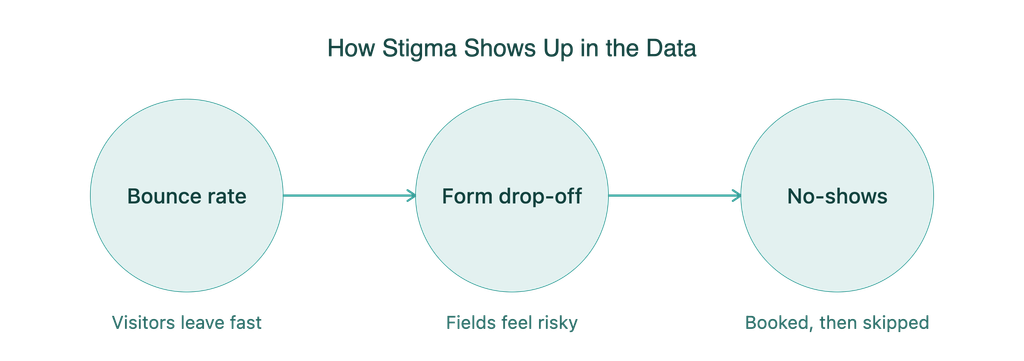
High Bounce Rate on Service Pages
A shame reflex kicks in when visitors see clinical, diagnostic language. They don’t find reassurance, the site doesn’t feel safe, and they close the tab. A sterile site full of clinical terminology doesn’t convert, because the visitor isn’t convinced this particular clinic can help someone like them.
Other contributors to bounce rate on these pages:
- CTAs placed in the wrong spot or worded in a way that signals urgency,
- no CTA at all,
- copy that never actually says where and how a visitor can reach out
- No information about the clinic or the people behind it, that shouldn’t live only on the About Us page
- No proof of expertise: years in practice, patient volume, anonymized testimonials, nothing to weigh the clinic against.
Contact Form Abandonment
We already covered that contact forms need to be short and ask for as little personal detail as possible. Each additional required field increases the sense of exposure.
There’s also a fear-driven paralysis around privacy. Visitors may worry about an email that gives something away, or a credit card statement that reveals the clinic’s name to someone who shouldn’t see it. There’s also the fear that an employer might find out.
The No-Show Effect
The no-show effect on consultations is real. Someone books, then backs out before the call, because seeking help still feels like admitting weakness to them.
That’s a signal that the site’s copy didn’t fully dissolve the stigma before the click. The visitor was convinced enough to book, but not reassured enough to follow through, and by the time the appointment date arrives, the same fear that kept them scrolling instead of booking earlier comes back. This is also the hardest of the three signals to fix through the website alone. Confirmation emails, a short reminder that reinforces confidentiality and normalizes hesitation, and even a low-pressure option to reschedule instead of simply not showing up, tend to help more here than any single page edit.
CRO Tactics That Reduce Stigma on Your Website
Fortunately there are tactics you can put into practice right away to reduce stigma’s impact on your conversions, so your SEO investment gets a better return, and your site is perceived by visitors as a safe place to seek treatment.
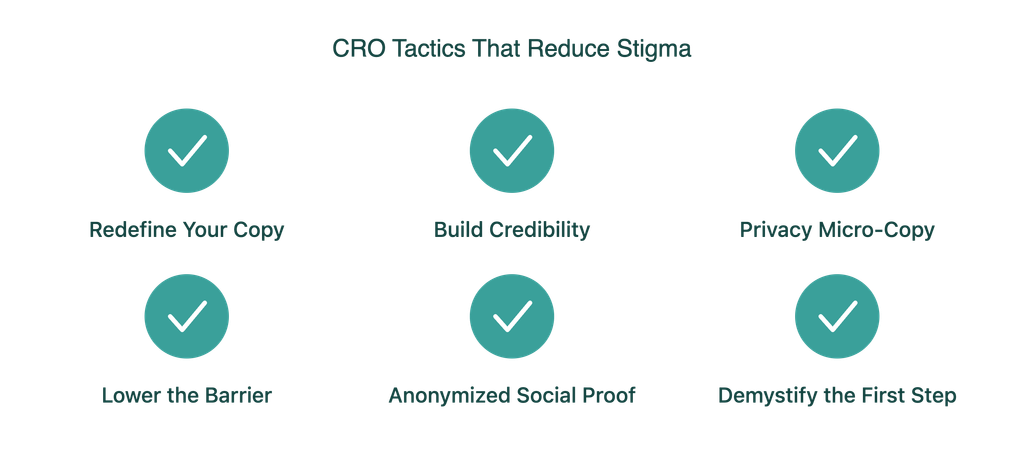
Redefine Your Copy
Replace clinical, diagnostic language with language that describes what someone actually gets out of showing up. Instead of “Treatment for severe anxiety disorders,” try “Tools to regain control in stressful moments.” The goal isn’t to flatter the decision to seek help, it’s to describe it accurately enough that it doesn’t sound like an admission of failure in the first place.
This doesn’t mean stripping the site of clinical terms entirely. Healthcare content has to stay accurate, and that means clinical language still belongs in service descriptions and anywhere specificity matters for EEAT and ethical standards. Empathy needs to run through that same copy too, not as a separate section but woven subtly through the SEO-optimized, clinical text itself, which usually means reading a page back several times before it actually strikes that balance.
Build Credibility and Trust Across the Site
A potential patient’s first contact with the clinic’s website should feel welcoming, lower resistance, and start building trust immediately. The homepage should show, in plain language, how many people the clinic has helped, how long it’s been operating, and what problems it treats and how.
Official statistics reduce resistance too. Someone with mental health issues needs to know they’re not the only one, even if they feel like the only one in their own circle.
It’s also worth including real photos of the facility, short notes on each clinician’s specialty and approach, and, where possible, a short video that shows how they actually talk to and work with patients.
Put together, credibility across the site comes down to a few consistent elements:
- Language that directly counters the stigma attached to each condition the clinic treats
- Clear, demonstrated expertise through real case outcomes, not just claims
- Condition-specific statistics that normalize the visitor’s experience
- General information about the clinic itself, including real facility photos
- Clinician expertise built into the copy through plain descriptions of specialty and approach, not a list of certifications
Place Privacy Micro-Copy Right Next to the CTA
Add specific, visible reassurance directly under the booking button, not buried in a policy page. Something like: “100% confidential and HIPAA compliant.” “Discreet billing statements, no therapy name shown.” “Your information is never shared with employers or third parties.”
The placement matters as much as the wording. These lines need to sit exactly where hesitation peaks, next to the button someone is about to click, not three scrolls away in a privacy policy written in legal language nobody reads under stress. The same logic applies to HIPAA compliant intake forms. If the form itself doesn’t visibly reflect that standard, the reassurance above it does most of the work of getting someone to actually fill it out.
Lower the Barrier to Booking, and to Showing Up
Many people under stigma can’t bring themselves to say their problem out loud to a stranger. Offer text-based booking through a short micro-questionnaire or an async chat, instead of requiring a phone call.
The same care needs to carry through after the booking is made. Confirmation emails, a short reminder that reinforces confidentiality and normalizes hesitation, and even a low-pressure option to reschedule instead of simply not showing up, tend to help more here than any single page edit.
Normalize the Problem Through Anonymized Social Proof
Anonymous statistics and quotes that communicate “you’re not the only one” work because isolation is often a bigger barrier than the condition itself. First-person client stories, written or approved with consent and stripped of identifying details, “I thought I was the only founder struggling with panic attacks…”, drastically reduce that sense of isolation and shame.
This works best when it’s specific rather than generic. A vague testimonial like “This clinic changed my life” does less than a short, concrete detail: what the person was avoiding before treatment, and what changed once they started. Specificity is what makes a stranger’s story feel like it could be the visitor’s own.
Demystify the First Step to Reduce Vulnerability
Not knowing what to expect at a consultation amplifies fear of judgment. Show a simple three-step process that makes clear the first conversation is purely introductory, with no evaluation, pressure, or obligation.
Does Reducing Stigma on a Website Actually Improve SEO, or Just Conversions?
Mainly conversions, not rankings directly. But a lower bounce rate and longer time on page are behavioral signals search engines do pick up on, so the effect on SEO tends to be indirect, and it shows up over time rather than immediately.
SEO Gets People to the Page. Whether They Stay Is a Different Problem.
Bringing traffic through SEO is only half the job when stigma is the barrier standing between a visitor and a booked appointment. A clinic can rank well, get the click, and still lose the visitor in the seconds after they land, not because the SEO failed, but because nothing on the page told them it was safe to stay.
The fastest change most clinics can make is also the lowest effort: privacy micro-copy next to the CTA, and a softer primary call to action. Neither requires a redesign. Both are copy and placement edits that can go live this week.
If your bounce rate is high on intake pages, or your conversions are lower than your traffic would suggest, that’s usually the first place worth looking at, not the technical side of your SEO, but whether your site is actually built to hold onto someone who has already decided to reach out.
We do SEO for behavioral health clinics where we address these issues. Learn how we help behavioral health clinics grow.
